Systems
AI Won't Kill Businesses. Average Execution Will.
Everyone gets the same hammer. The advantage is in the factory you design, what it learns, and how fast you improve it.
By Mohanad Anan 5 min read

In this essay · 4 sections
Thinking that AI will make all businesses and services obsolete is a fallacy.
Think about it.
If all car manufacturers have access to basically the same tools, machines, materials, and technology, why can they still compete with each other? Why do they create different products, with different levels of quality, performance, and value?
If the hammer and the metal are the same, why isn’t every car the same?
Because it has never been about the tools. It’s about what you do with them.
“But Mohanad! AI is different. AI doesn’t just give you the tools, it actually does the execution for you. So where’s your competitive advantage?”
Wrong. Or at least, you’re missing something important.
Yes, AI executes. AI writes, designs, builds, automates, and ships.
But here’s the question:
What exactly is it executing?
That’s where the real competitive advantage begins.
Of course, if your entire business consists of delivering pretty average services that someone can replicate with a single prompt, then yes, you’re screwed, my friend.
And perhaps you should be.
But if you use this incredible technology to build your own internal systems, systems that don’t just produce outputs, but consistently deliver the desired outcomes, then I believe you’re going to thrive.
And here’s how I think about it.
Your Business Is a Factory. Your Systems Are the Intellectual Property.
Imagine your business as a car factory.
The customer doesn’t necessarily care which machines you’re using, how your assembly line is structured, or how many times you’ve upgraded your production process.
They care about the car they receive.
The quality. The reliability. The experience. The outcome.
And behind the scenes, you’ve built an entire system designed to deliver exactly that.
That’s how I believe we should start thinking about businesses in the AI era.
Not as a collection of people manually delivering services, but as an increasingly sophisticated collection of internal systems, working together to produce a desired outcome.
And those systems become your competitive advantage.
Because nobody outside your business necessarily knows how they work.
They don’t know the logic behind your decisions, the workflows you’ve designed, the feedback loops you’ve implemented, or the hundreds of little improvements you’ve made along the way.
And most importantly, they don’t have your accumulated experience of what works and what doesn’t.
Yes, someone could use the exact same AI models as you.
They could even ask AI to build a similar system.
But having access to the same technology doesn’t mean having the same understanding of the problem, the same strategy, or the same ability to recognize what a great solution looks like.
Just like having access to the same machines doesn’t automatically make you Ferrari.
The Real Advantage Is in the Feedback Loop
Here’s another part that I find fascinating.
The more your systems operate in the real world, the more opportunities you have to improve them.
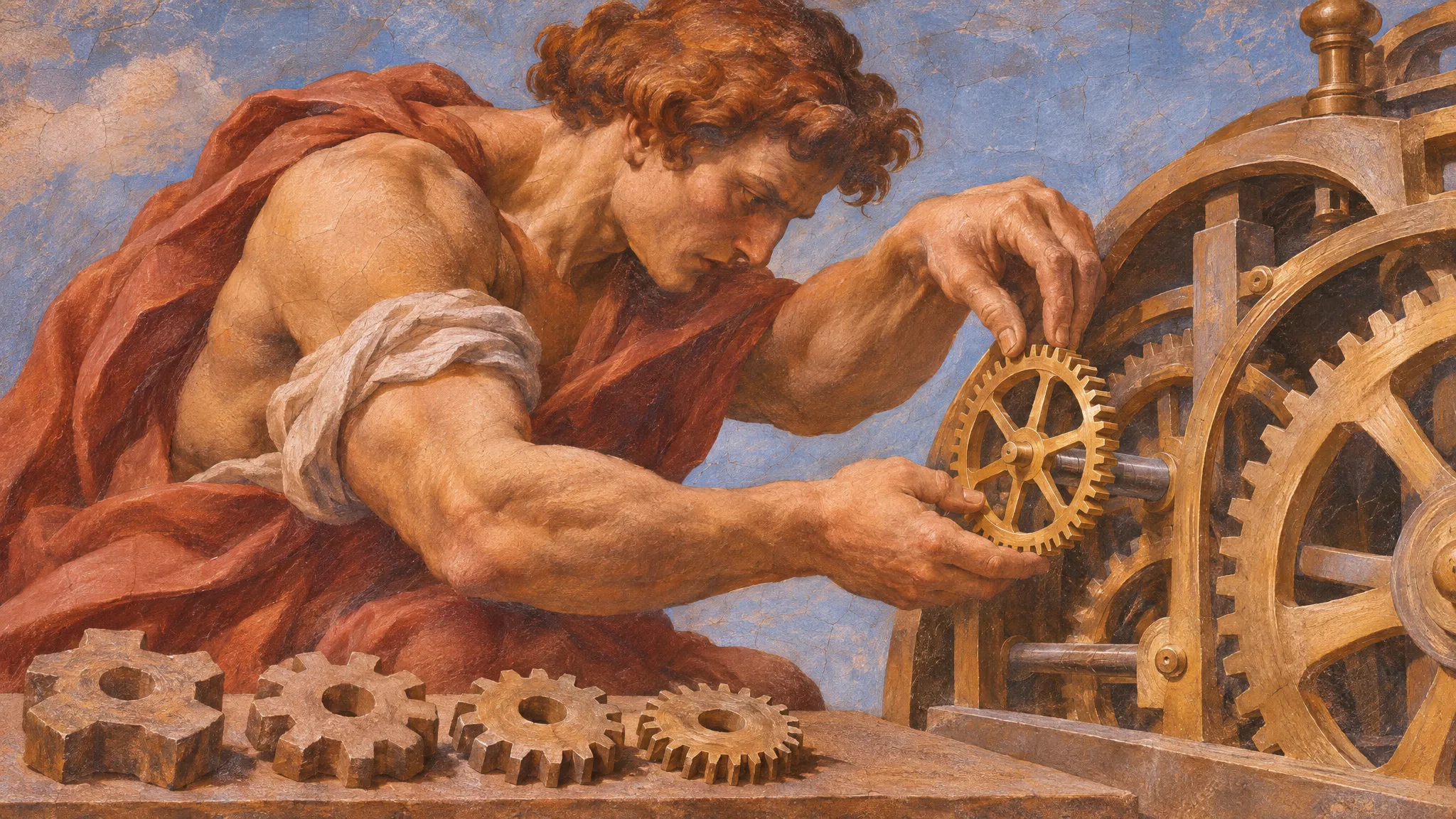
You build a system.
You put it to work.
You observe the results.
You discover what’s working, what’s failing, and what could be done better.
Then you upgrade it.
Again. And again. And again.
And because AI has made building and modifying software incredibly fast and inexpensive, the time between identifying a problem and implementing a solution can become ridiculously short.
Think about what that means.
Your business is no longer just delivering a service.
Your business is continuously improving the machine that delivers the service.
Every customer interaction, every failure, every successful outcome can potentially become another improvement to the system.
Over time, those improvements compound.
And while your competitors might have access to the same AI models, they don’t automatically have access to your history of experiments, your operational knowledge, or the decisions that shaped your system.
Of course, none of this makes your business impossible to copy.
But it makes competing with you a lot more complicated than simply writing the same prompt.
AI Can Build the Factory. But Who Designs It?
Now, you might argue:
“But AI is also designing the systems. So how is any of this your intellectual property?”
And I think this is where people confuse execution with direction.

AI can help you design, build, and operate the factory.
But what should the factory produce?
What problem is actually worth solving?
What does a successful outcome look like?
Which trade-offs are acceptable?
What should you measure?
And when something fails, what exactly should change?
These questions require judgment.
And that judgment is shaped by your experience, your understanding of your customers, your creativity, your vision, and your ability to connect things that other people might not even recognize as connected.
The AI-generated code itself might not be your competitive advantage.
The system you’ve designed, the knowledge embedded within it, and your ability to keep improving it might be.
That’s the distinction.
Stop Asking How to Win in AI
Every day, I’m trying to change the question I ask myself.
Instead of asking:
“How do I win in AI?”
I’m asking:
“How can I build my own systems that consistently deliver the outcomes I want, in my own way?”
And perhaps even more importantly:
“How can I design those systems so that improving, upgrading, and iterating on them becomes ridiculously fast and easy?”
Because I don’t believe the winners of the AI era will necessarily be the people who know the most prompts, use the most agents, or generate the most code.
I believe they’ll be the people who understand their problems deeply enough to design systems that solve them better than everyone else.
And who can improve those systems faster than everyone else.
The tools are becoming accessible to everyone.
The ability to build is becoming accessible to everyone.
But knowing what is worth building, why it matters, and how to make it better is an entirely different game.
And that’s the game I want to play.
AI is not the competitive advantage. What you build with it, what you learn from it, and how fast you improve it is.
Mohanad
Düsseldorf, 30 October 2026